Experimental Investigation and Performance Enhancement of a Solar Still Using a Solar Air Collector for Freshwater Production under Winter Conditions in Arid Algeria
DOI:https://doi-001.org/1025/17866907646016
M. Chelgham a,b, A. Ouakkaf c , F. Chelgham d,e* ,M. M. Belhadj a,b
a Développement des énergies nouvelles et renouvelables dans les zones arides et sahariennes, LENREZA, P.O. Box 511, Ouargla 30 000, Algeria
b Faculty of Mathematics and Material Sciences, Kasdi Merbah University, Ouargla-30000, Algeria
c Faculty of Exact Sciences, Mohamed Khider University, Biskra-07000, Algeria
d Laboratory for Valorization and Promotion of Saharan Resources, Kasdi Merbah University, Ouargla – 30000, Algeria
e Faculty of Hydrocarbons, Renewable Energies, Earth and Universe Science, Kasdi Merbah University, Ouargla-30000, Algeria
Received : 23/06/2024 ; Accepted : 27/11/2024 ; Published : 19/12/2024
Abstract
Freshwater scarcity and environmental pollution represent major challenges to the sustainable development of human societies. Solar distillation is considered an effective solution to address these issues. However, a significant limitation arises during winter due to the decrease in system productivity. This study aims to overcome this limitation by modifying the experimental setup through the integration of a flat-plate solar air collector, designed to reduce thermal losses during winter conditions. The experimental data presented in this work were obtained over three representative days in southern Algeria (Ouargla City).The results indicate that the daily productivity of a conventional solar still reaches 3.7 kg m⁻² in summer and decreases to 1.5 kg m⁻² in winter. In contrast, the modified solar still equipped with an air heater achieves a winter productivity of 3.6 kg m⁻² per day. While the conventional solar still without air heating performs best during summer, its performance significantly declines in winter due to increased thermal losses. The measured thermal losses of the conventional and modified systems in winter are 81.055 W and 20.670 W, respectively. Variations in heat loss from day to day are mainly attributed to changes in ambient temperature and wind speed. A reduction in thermal losses leads to increased daily productivity in the conventional system, whereas the modified system shows negligible sensitivity to these variations.
Keywords: Distillation, Solar air collector, heat loss, Thermal infusion, solar radiation
1. Introduction
Drinking water is essential for human life and is also widely used in agricultural and industrial activities. However, freshwater consumption has increased considerably worldwide as a result of population growth and the continuous expansion of industrial and agricultural activities. Consequently, desalination has become an important approach for producing freshwater from saline water. Conventional desalination technologies are generally associated with high energy consumption and depend largely on fossil fuels, such as natural gas and coal, which contribute significantly to environmental pollution and greenhouse gas emissions. In this context, solar distillation has emerged as an environmentally friendly alternative because it utilizes abundant solar energy to produce freshwater with limited environmental impact. The historical development of solar distillation dates back to the nineteenth century. In 1870, Wheeler and Evans were granted the first American patent related to solar distillation based on their experimental work [9]. Two years later, in 1872, Charles Wilson constructed the first conventional solar still plant in Chile. The plant consisted of a wooden basin with a surface area of approximately 4,700 m² and produced about 23,000 L of freshwater per day, corresponding to a productivity of approximately 4.9 L/m² of solar still area per day. This large basin-type solar still was designed to supply freshwater from highly saline water and remained operational for more than 40 years [12].Solar distillation essentially reproduces the natural hydrological process of water purification. The operating principle is relatively simple: solar radiation heats the saline water until evaporation occurs. The generated water vapor rises and subsequently condenses on the inner surface of the transparent cover, where the condensed freshwater is collected [29]. The thermal and productivity performance of a solar still is affected by several operating and environmental parameters, including basin water depth, basin material, wind velocity, solar radiation intensity, ambient temperature, and cover inclination angle [10].Although numerous modifications have been proposed in terms of geometry, materials, construction techniques, and operating conditions [8], most solar still configurations are based on the same fundamental evaporation–condensation mechanism. Malik et al. [23] presented a comprehensive review of different solar still configurations. A conventional basin-type solar still generally consists of an airtight basin containing a shallow layer of saline water, an inclined transparent cover, commonly made of glass, and supporting side walls. The transparent cover allows solar radiation to reach the saline water while providing a surface for vapor condensation. The thermal behavior and productivity of basin-type solar stills have been extensively investigated [12].Compared with more sophisticated desalination configurations, conventional solar stills offer the advantages of simple construction, low operating costs, and relatively easy maintenance. Nevertheless, conventional basin-type solar stills [8,10,23,29] generally exhibit relatively low thermal efficiency and limited daily freshwater productivity [16,17,43,46]. Therefore, considerable research has focused on developing and modifying conventional solar stills to enhance their thermal performance and freshwater yield. One of the most common approaches has been the integration of solar thermal collectors to provide additional thermal energy to the distillation system [35,46].Various solar still configurations have subsequently been investigated, ranging from conventional systems, such as single-basin and double-basin single-slope solar stills, to hybrid configurations incorporating thermal or photovoltaic solar collectors [33,36,46]. For example, evacuated tube collectors have been integrated with solar stills to improve the thermal energy supplied to the saline water. In one study, fourteen double-wall evacuated glass tubes were installed at an inclination angle of 45° from the horizontal. The inner tubes were coated with a selective Al-Ni/Al compound coating to enhance solar energy absorption, while the outer tubes were transparent. The integration of the evacuated tubes increased the water temperature inside the solar still and consequently improved distillate production [32]. Similarly, a single-basin solar still coupled with an evacuated tube collector was investigated. The inner surface of the basin was painted black to enhance solar radiation absorption. For a water mass of 50 kg, a daily freshwater yield of 6.8 kg was obtained, which was higher than the productivity reported for several passive solar stills [37]. Sampathkumar and Senthilkumar also experimentally investigated a hybrid solar distillation system with the objective of improving the utilization of solar energy and increasing freshwater productivity. Compared with a passive solar still, coupling an evacuated tube solar water heater with the still increased productivity. When the temperature of the water in the storage tank reached approximately 60 °C, connecting the solar collector to the solar still resulted in a 77% increase in freshwater yield [38].
In another experimental investigation involving a solar still coupled with a flat-plate collector (FPC) operating under natural circulation, Dwivedi and Tiwari [13] reported that the thermal efficiency of the active solar still was lower than that of the corresponding passive solar still. Nevertheless, integrating a flat-plate collector with a single-basin solar still under natural circulation increased freshwater productivity by approximately 30–52% [3,4,25,41]. Another study investigated the performance of conventional single-slope solar stills and examined the effects of integrating a flat-plate collector (FPC) and a parabolic trough collector (PTC) supported by a packaged glass-ball layer (PLGB), which served as a thermal storage medium. The FPC–PTC–PLGB configuration demonstrated substantially higher freshwater production than the conventional solar still. For conventional solar stills, daily freshwater productivity ranged from 1.02 to 1.988 kg/m² during winter and summer conditions, whereas the FPC–PTC–PLGB configuration achieved approximately 2.775–6.036 kg/m² per day [5,27,28,40].Solar thermal technologies have also been extensively investigated for applications beyond water desalination. Solar air collectors, for example, have attracted considerable attention because of their simple configuration, ease of operation, and satisfactory thermal performance. These systems can be effectively applied to agricultural drying processes [1,2]. Mennouche and Bouchekima [30] developed, constructed, and experimentally evaluated an indirect natural-convection solar dryer incorporating a solar air collector for peanut drying under local climatic conditions. The experimental results showed that the peanut samples reached a final moisture content of 8.31% after three days of drying, corresponding to a moisture reduction of approximately 34.1%. In addition, the integration of solar air collectors into rural dwellings has been reported as a promising approach for supporting clean heating applications and improving indoor thermal comfort [19].Despite these developments, heat loss remains one of the major limitations affecting the performance of solar stills. In passive solar stills, heat losses can generally be classified into external and internal losses. External losses include heat losses through the top cover, bottom, and side walls, whereas internal losses mainly involve radiative, convective, and evaporative heat transfer mechanisms [46].
Reducing these losses and improving the utilization of available thermal energy are therefore essential for enhancing solar still productivity.Waste heat recovery represents another promising strategy for improving the performance of solar desalination systems, particularly during periods of low solar radiation. The performance of a solar still can be enhanced by recovering waste heat from a diesel engine and transferring it to the saline water, particularly during winter conditions. Such an approach has been reported to reduce the cost of produced freshwater to approximately half that of water generated using conventional methods [34]. Ouyang and Wang et al. [31], for instance, investigated waste heat recovery from the flue gas of natural-gas engines as a thermal energy source. An integrated system comprising a supercritical carbon dioxide Brayton cycle, a double-effect absorption refrigeration system, and a Kalina cycle was developed. Thermodynamic and economic analyses indicated that the proposed configuration increased the output power by 15.33% and reduced the payback period by approximately 25.6%. Similarly, Panchal and Thakkar [32] reported that the use of evacuated tubes can reduce heat losses by enhancing the utilization of available solar energy, thereby increasing the temperature of the saline water and improving distillate production.Waste heat recovery has also been investigated using Organic Rankine Cycle (ORC) technology. The ORC is particularly attractive for waste heat recovery because it can utilize low-, medium-, and high-temperature heat sources. Consequently, ORC-based systems can contribute to reducing CO₂ emissions while improving the overall sustainability and energy efficiency of thermal systems [26]. Experimental investigations have also been conducted on a floating-wick basin-type vertical multiple-effect diffusion solar still with waste heat recovery (FW-BVMED-HR). The economic performance of the system was evaluated over a life-cycle period of 10–25 years, and the minimum estimated freshwater production cost was approximately Rs. 5.45/kg [20].Heat-pipe heat exchangers (HPHEs) have also gained increasing attention as a technology for recovering low-grade waste heat in energy-intensive industrial applications. Prior to implementation, numerical modeling of the heat exchanger and the overall system is essential to assess its potential contribution to energy recovery. Such modeling can also be used to estimate potential energy savings and emission reductions and to optimize waste heat utilization. TRNSYS is one of the simulation platforms commonly employed for this purpose. Previous studies have reported that the model can predict outlet temperatures and recovered energy with an accuracy of approximately 15%, with an average error of about 4.4% [6].
Despite the extensive research conducted on solar desalination, most experimental investigations have focused on summer conditions, while relatively few studies have addressed solar still performance during winter. This represents an important research gap, particularly for arid and semi-arid regions where seasonal variations in solar radiation and ambient temperature can significantly affect distillation performance. Therefore; the main objective of the present experimental study is to investigate freshwater production using a conventional solar still (CSS) under winter conditions in an arid region of Algeria. The proposed modification consists of recovering and utilizing the air thermal energy inside the solar still by enclosing the still within a wooden box connected to a flat-plate solar air collector (FPAC), as illustrated in Fig. 1 [38]. The heated air circulates through the system under natural-convection conditions, with the aim of maintaining the temperature of the different components of the solar still and consequently enhancing its thermal performance.The experimental investigation focuses on the temperature evolution of the main solar still components and the associated thermal losses in both the conventional and modified configurations. Furthermore, the production of distilled water from saline water is experimentally evaluated and compared for single-slope solar still configurations. The quality and salinity characteristics of the saline water and produced distilled water are also examined . The study is particularly relevant to the Ouargla region, where groundwater is characterized by relatively high salinity compared with several other regions in southern Algeria. The results are expected to provide useful information regarding the feasibility of solar distillation under winter climatic conditions and the potential of integrating solar air collectors to improve the thermal performance and freshwater productivity of conventional solar stills.
2. Materials and methods
The simplest and cheapest device for converting brackish or contaminated water into pure, drinkable water. The hydrological cycle is modeled with this technique. Solar energy passes through the glass cover, is absorbed by the black plate, and then transferred to the seawater in the still evaporation basin. The present research focuses on improving the still’s production by utilizing waste heat from the still via a solar collector. This experiment was based on two distillates. The first conventional solar still and the second modified one, the proposed solar still to work as a Natural Circulation Circle (NCC) operating under the effect of air (glass cover, absorber plate, water supply, insulation), the absorber plate, which was painted black and resistant to temperatures of up to 600 °C to increase the absorptivity of the solar radiation, The water depth is 0.01 m [42]. A glass sheet with a thickness of 4 mm is applied to the top surface. The glass cover and the air collector were angled at 30 degrees [7,24,45]. Thermocouples are used to measure temperature. The temperature of the glass cover, water, and absorber plate is measured using k-type thermocouples. The conventional solar still has a surface area of 0.185 m2 and a surface area of 0.823 m2 with a flat plate collector (the conventional inter-the wooden box is 0.185 m2 and the wooden box is 0.421 m2 and the flat plate air collector is 0.638 m2). The flat plate air collector is linked to a single slope solar still in such a way that hot air from the collecting plate passes via the natural circulation circle and into the wooden box. It entails slowly pouring saline water into the basin to maintain the water depth. A cross-sectional view and a snapshot of a single-slope solar still system Figure 1 shows the system in its native states (a and b, respectively).
(a)

(b)
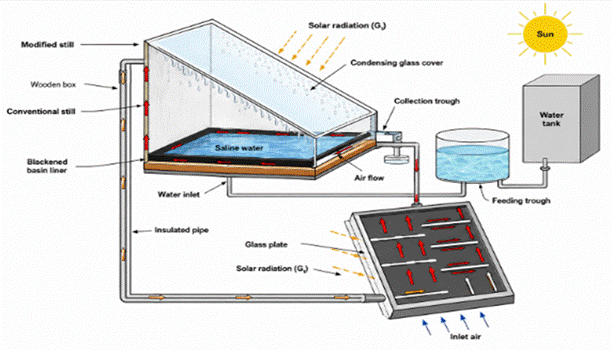
Fig.1. (a), Photograph of the single slope solar still with the solar air collector
(b) Schematic diagram of the solar still.
3. Equations for modeling single solar still coupled with energy balance
The statements bellow have been taken into account when creating energy balance equations for various
components of a single slope passive solar still.
1-The system is operating in a quasi-steady state.
2-The tubing connecting the solar still to the flat plate collector is completely insulated.
3-Simplifications:
We neglect the heat transfer by connecting to the sidewalls. This is due to the thickness and quality of the wood insulating.
Ignoring the rays reflected by water is due to the fact that the reflectivity is low compared to the absorbance.
Ignoring the existence of heat loss between the Insulation under the basin and the environment is due to the equal external temperature of the insulator and the environment.
Writing energy balance equations (1), (2) and (3) for various elements of a single-slope solar still
Energy conservation equation glass

Energy conservation equation water

Energy conservation equation the basin
In conventional solar still

In modifier solar still with collector
4. Experimental setup
The experimental work was performed at the Lab. New and renewable energy development in arid and Saharan areas, LENREZA, Ouargla, Algeria (30°52′N, 5°34′E) Department of Physics, Faculty of Mathematics and Material Sciences, University of Ouargla, Algeria in the month of December in the year 2022 and January and February and July 2023 . From 08:00a.m to 18:30p.m, water productivity was measured with 1h intervals during all days of the experiment. The city of Ouargla, in Algeria’s southeast, is facing , and has a total area of around 211 980 km2. Its climate is arid, and it is in the middle of the desert where the average temperature during the hottest months exceeds 45°C and the relative humidity does not exceed 19% [48].
5. Result and discussion
Experiments were carried out in order to better understand the performance of the solar still when used in conjunction with the solar air collector.
5.1. Climatic characteristics of the day of the experiment
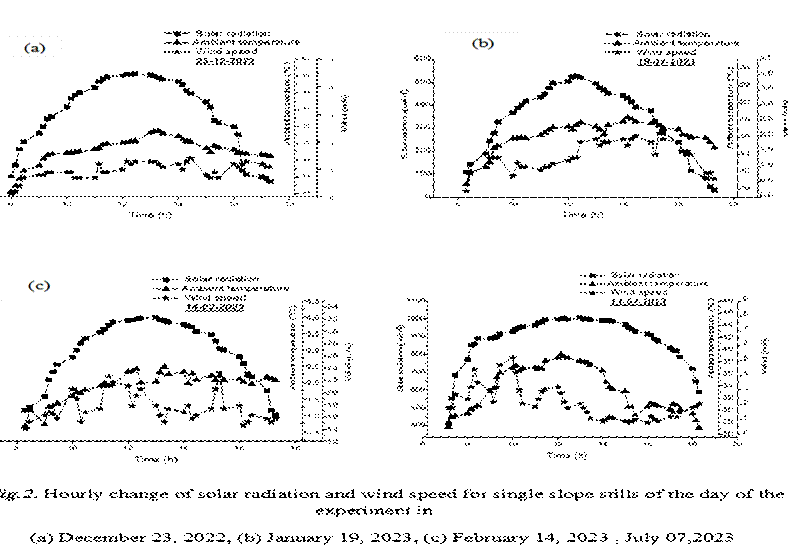
Figure 2(a to d) depicts the environmental variables used in the modeling, such as solar radiation, ambient temperature, and wind speed, on the day of the experiment, December 2022, and January and February and July 2023, with analyzed solar radiation and wind speed. It calculates solar intensity and wind speed. The maximum during the peak was higher, up to 12.45 pm.
Fig. 2.a.the solar radiation is 487 W/m2 and the ambient temperature is 20.2 °C, with a wind speed of 1 m/s. In Fig. 2.b, the solar radiation is 530 W/m2, the temperature is 15.1 °C, and the wind speed is 1.3 m/s. Fig. 2.c. the solar radiation is 441 W/m2, the temperature is 21.2 °C, and the wind speed is 1.25 m/s. Fig. 2.d. the solar radiation is 1007 W/m2, the temperature is 34.47 °C, and the wind speed is 2.11 m/s.
5.2. Effect of CSS-FPAC of the different temperature on distillation
A comparison between the hourly variation of temperature for modified and conventional solar stills were performed and illustrated in Fig. 4 and Fig.5.
Fig.3.a. the temperature basin of 47.6.4°C – 51.4 °C and the temperature glass of 36. 4°C – 40.2 °C and temperature ambient 20.2 °C in December 23, 2022.Fig. 3.b. The temperature basin of 44.1°C – 45.0°C and the temperature glass of 26.0°C – 35.4 °C and temperature ambient 15.1 °C in January 19, 2023.Fig. 3.c. The temperature basin of 53.9.6.4°C – 54.2 °C and the temperature glass of 40.3°C – 42.6 °C and temperature ambient 21.2 °C in February 14, 2023.

Fig.3. Hourly change of temperature differences in conventional and modified solar still of the day of the experiment in (a) December 23, 2022, (b) January 19, 2023, (c) February 14, 2023
The temperature differences in the CSS are lower than in the CSS-FPAC, therefore the modified one kept its elements temperature, but the conventional did not. The CSS is affected by the ambient temperature, but the CSS-FPAC is unaffected.
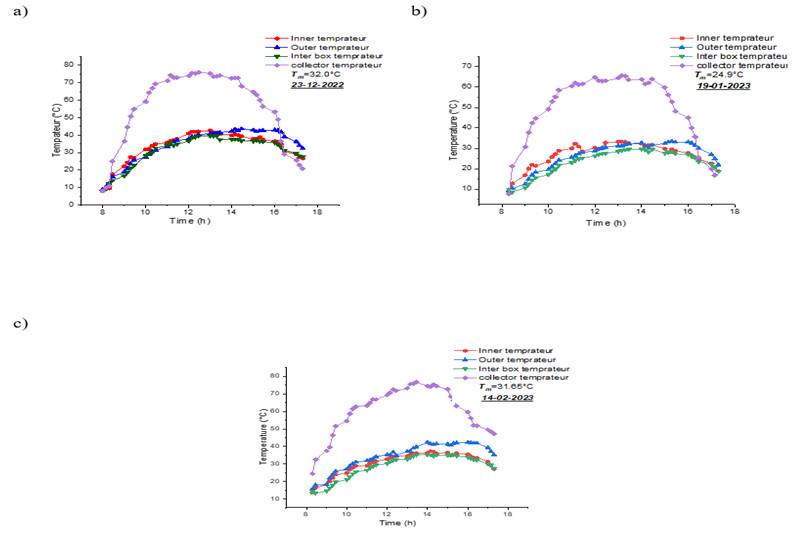
Fig.4. Variations in basin temperature, as well as inner and outer , inside of the wooden box temperature, and collector temperature , hourly
Figure 4(a to c (Shows that inner and outer and inside of the wooden box temperature, and collector temperature for the month of December 2022 and January and February 2023 daily experiments of slope solar stills. Fig.4. a. the collector is 55.3°C. and inner 34.0°C and outer 34.1°C and inside wooden box °C . Fig.4. b. the collector is 49.3 °C and inner 26.8°C and outer 26.7°C and inside wooden 26.7°C . Fig.4. c. The collector is 60.4°C. and inner 30.7°C and outer 34.6°C and inside wooden box 32.6°C.
The temperature of the inner and outer, as well as the inside of the wooden box, is identical in the morning. From Fig.4, it can be noticed that at Tm = 32.0°C and Tm = 31.65°C, the outer temperatures are higher than the inner temperatures and the inside temperatures of the wooden box after 1.00 p.m. and the outer temperatures of the experimental day are 40.8°C–40.2°C, while at Tm = 24.9°C, after 2.00 p.m., the outer temperature is 30.6°C.Because the system is in a condition of heat storage in the morning, but after 1.00 p.m. On December 23 and February 14, but on January 19, after 2:00 p.m., it reaches saturation and begins to lose heat, which explains the high temperature of the exit wooden box. Therefore, the flat plate solar air collector can be set aside after this time.
5.3. Effect of using CSS-FPAC of the thermal losses
Using CSS-FPAC may have advantages ( solar still inside the wooden box coupled with Plat Solar Air Collector). Low thermal losses are shown in Fig.5. Thermal loss variation in conventional and modified buildings in December 2022, January and February 2023. Fig.5. a. The difference was large; the thermal loss of the conventional varies between -6.794 W – 57.122 W and the rate from -6.254 – W 24.252 W . Fig.5.b. the thermal loss between -5.70 W – 73.727 W and -4.191 W – 20.670 W. Fig.5. c. the rate of heat loss reduction between -1.992 W – 81.055 W and -2.428W – 23.308 W is 62.7%, 69.97%, and 69.72%. and in comparative the three days of the experiment for modified solar still show of Fig.5.d. The day February 14, 2023, and December 23, 2022, is height of thermal loss.
The change in heat loss from day to day is caused by a Tm, which is regulated by ambient temperature and sun radiation and determines how much heat is lost from day to day. The thermal loss is proportional to Tm.
Fig.5. Differences of thermal losses in to conventional and modified of the day of the experiment in (a) December 23, 2022, (b) January 19, 2023, (c) February 14, 2023.
The lower ambient temperature and higher wind speed (Figur.2) increased the heat loss in conventional solar stills compared to the modified ones because of the exploitation of heat loss. The high thermal loss in the conventional solar still means the difference between basin and ambient temperature, but the modified solar still lowers the difference. because of the lack of direct contact with the environment .
.
5.4. Effect of using CSS-FPAC of the productivity
A comparison of daily productivity (10h and 30 min) for both conventional and modified solar stills at different medium temperature of the wooden box (Tm) is shown in Fig. 5.

Fig.6. Hourly fluctuations in medium temperature and water productivity rate predicted and measured during the month of (a) December 23, 2022, (b) January 19, 2023, (c) July 07,2023,
(d) Comparative the three days.
Fig. 6.a. shows that the productivity of CSS and CSS-FPAC crops has increased significantly and clearly from 1.697 m-2 to 3.362
m-2, with a difference of 1.573
m-2 at Tm = 32.0 °C. In this case, the increase in water productivity for modified solar stills was 98.09% greater than that for conventional solar stills. Fig. 6. b. The increase in modified is much greater than the increase in conventional, 1.724
m-2 to 2.919
m-2 and the difference is 1.195
m-2 at Tm = 24.9 °C and the improvement percentage was 69.28% greater than that for conventional solar stills, Fig. 6.c. the productivity from 2.092
m-2 to 3.357
m-2 and the difference is 1.265
m-2 at Tm = 31.65 °C and 60.46% of the advance percentage.
It can be observed that the hourly yield for CSS-FPAC is higher than CSS. which could be owing to the thermal loss exploited by the solar still temperature conservatism. On the other hand, the decrease in productivity is due to the decrease in ambient speed, which contributes to the lack of cooling of the glass, i.e., the lack of condensation.
Productivity is reduced when the medium temperature (Tm) is lower. It increases the water productivity because of the elevated Tm.
Fig.6.d. show the comparative of the water productivity between the CSS-FPAC of month February 19, 2023, and December 23,2022 on winter and CSS of month July 07,2023, on summer.
Where the productivity of the month December was is 3.3622 l m-2 and February is 3.357 l m-2 of the modified and comparative with July is 3.719 l m-2 of the conventional.
6. Conclusion
The followings are some of the conclusions we have reached:
6.1. Loss of heat
Higher daytime wind speeds and lower ambient temperature increased heat loss in conventional solar stills compared to modified ones due to heat waste.
The idea consists of generating an air flow through a natural circulation circle attached to the rear side of the still.
The change in heat loss from day to day is caused by the Tm, and thermal loss is proportional to the Tm.
Through this, experimental work can be set aside after 12.30 p.m. on the flat plate solar air collector because of the exploitation of heat loss before the wooden box.
The thermal performance of a single-single basin passive solar still was investigated under the following conditions: ambient temperature and wind speed. The conditions are variable, so the best solution is to couple the solar still with a flat-plate solar air collector.
6.2. The daily productivity
When the slope of the glass cover (solar still and solar air collector) is equal to the latitude of the location, the annual yield is at its highest.
The daily production of both CSS and CSS-FPAC was measured and found to be in proportions of 1.697 l m-2- 1.724 l m-2 and 3.357 l m-2 -3.362 l m-2on month December, January, February. and the improvement percentages were 98 %, 69.28%, and 60.46%.
Productivity is reduced when the medium temperature (Tm) is lower. The elevated Tm It increases the water productivity.
The yield of water productivity is higher during the summer than in the winter of CSS still, Also water productivity for CSS-FPAC in winter is equal to that of CSS in the summer, Where the modified was 3.357 l m-2- 3.3622 l m-2, and conventional, it is 3.719 l m-2.
The water in the Ouargla region is extremely high in fluorine. Monitoring drinking water and controlling fluorosis is essential to avoid potential health risks.
| Nomenclature | ||||
| thermal loss of conduction | area ( | A | ||
| Volume | (J/(kg·K))specific heat at constant pressure | Cp | ||
| Water | w | distance ( | D | |
| Greek symbol | Radiation solar | G | ||
| Emissivity | heat transfer coefficient (HTC) basin | H | ||
| Absorptivity | ||||
| Transmissivity | thermal conductivity | K | ||
| Reflectivity | length of the flat plate ( | L | ||
| Stefan–Boltzman constant (5.6697 ×10^8 | Mass | m | ||
| Abbreviations | heat transfer rate(HTR) | Q | ||
| Natural Circulation Circle | NCC | temperature (° | T | |
| Flat Plat Solar Air Collector | FPAC | Time ( | t | |
| Conventional Solar Still | CSS | wind speed | V | |
| Conventional Solar Still with Flat Plat Solar Air Collector | CSS-FPAC | overall heat loss | U | |
| Wooden box coupled with Plat Solar Air Collector | WB FPAC | Subscripts | ||
| Ambient | a | |||
| Basin | B | |||
| Convection | C | |||
| Radiation | R | |||
| Evaporative | ev | |||
| Glass | g | |||
| Actual of the planetarium | sky | |||
| Wooden box | Box | |||
| Insulator | iso | |||
| Collector | coll | |||
Referenes
1. L. Abhay, V. P. Chandramohan, V. R. K. Raju, Numerical analysis on solar air collector with
artificial roughness for indirect type solar dryer, J. Clean. Prod., 298, 126785 (2021). DOI:
10.1016/j.jclepro.2021.126785
2. Rajnish Azad, Sushant Bhuvad, Atul Lanjewar, Experimental and numerical study of solar air
heater with discrete arc ribs, Int. J. Therm. Sci., 174, 107274 (2021). DOI:
10.1016/j.ijthermalsci.2021.107274
3. Ali A. Badran, Ihmad A. Al-Hallaq, Imad A. Eyal Salman, Mohammad Z. Odat, Solar still
integrated with flat-plate collector: Experimental study, Desalination, 540, 116192 (2022). DOI:
10.1016/j.desal.2022.116192
4. O. O. Badran, H. A. Al-Tahainch, Effect of coupling flat-plate collector on solar still productivity under arid conditions, Desalination, 554, 116411 (2023). DOI: 10.1016/j.desal.2023.116411
5. Evangelos Bellos, Christos Tzivanidis, Concentrating solar thermal collectors with and without
nanofluids: Recent advances, J. Therm. Anal. Calorim., 147, 3691–3710 (2022). DOI:
10.1007/s10973-022-11645-0
6. Daniel Brough, João Ramos, Bertrand Delpech, Hussam Jouhara, TRNSYS modeling of heat
pipe exchangers for waste heat recovery: Validation and application, Int. J. Thermofluids, 15,
100123 (2022). DOI: 10.1016/j.ijft.2022.100123
7. Hamza Bouguettaia, Ridha Cherraye, Bachir Bouchekima, Djamel Bechki, Abderrahmane
Khechekhouche, Tilt angle effect on solar still productivity in arid conditions (South Algeria), Int. J.Ambient Energy, 44, 1875–1884 (2023). DOI: 10.1080/01430750.2022.2084523
8. P. I. Cooper, Absorption of radiation in modern solar still designs, Sol. Energy, 210, 347–359
(2021). DOI: 10.1016/j.solener.2020.11.052
9. Delyannis, Historic and recent developments in solar desalination and renewable energies,
Desalination, 536, 115939 (2022). DOI: 10.1016/j.desal.2022.115939
10. Naresh K. Dhiman, Transient analysis of spherical solar still with optimized design parameters, Desalination, 550, 116567 (2023). DOI: 10.1016/j.desal.2023.116567
11. Vimal Dimri, Bikash Sarkar, Usha Singh, G. N. Tiwari, Effect of condensing cover material on active solar still yield: Experimental validation, Desalination, 540, 116211 (2022). DOI:
10.1016/j.desal.2022.116211
12. John A. Duffie, Solar Engineering of Thermal Processes: Updated Concepts in Solar Thermal
Systems, Wiley, 3rd edition (2019). DOI: 10.1002/9781119425726
13. V. K. Dwivedi, G. N. Tiwari, Experimental validation of thermal model of double slope active solar still under natural circulation, Desalination, 570, 116671 (2023). DOI:
10.1016/j.desal.2023.116671
14. A. A. El-Sebaii, Effect of wind speed on active and passive solar stills: Experimental and
numerical study, Energy Convers. Manage., 265, 115754 (2022). DOI:
10.1016/j.enconman.2022.115754
15. A. A. El-Sebaii, Influence of glass cover temperature on passive solar still performance under
variable wind conditions, Energy, 254, 124100 (2022). DOI: 10.1016/j.energy.2022.124100
16. Hassan E. S. Fath, Design and performance analysis of high-efficiency two-effect solar
distillation units, Energy Convers. Manage., 248, 114853 (2021). DOI:
10.1016/j.enconman.2021.114853
17. A. Mohandass Gandhi et al., Performance enhancement of stepped basin solar still using
advanced adaptive control techniques, Desalination, 535, 115995 (2022). DOI:
10.1016/j.desal.2022.115995
18. H. P. Garg, H. S. Mann, Effect of climatic, operational, and design parameters on solar stills
under arid conditions: Updated study, Sol. Energy, 235, 372–384 (2022). DOI:
10.1016/j.solener.2022.03.045
19. Yan Jiang et al., Comparative study of triangular solar air collector with tilted transparent cover plate, Sol. Energy, 231, 43–56 (2022). DOI: 10.1016/j.solener.2022.01.035
20. A. K. Kaushal et al., Productivity and economic analysis of floating wick basin multiple-effect
diffusion solar still with waste heat recovery, Desalination, 532, 115841 (2022). DOI:10.1016/j.desal.2022.115841
21. Mohamed Amine Kerdoun et al., Fluoride concentration in bottled drinking water from endemic regions: A market-based survey, Clin. Nutr. ESPEN, 57, 147–154 (2023). DOI:
10.1016/j.clnesp.2023.03.014
22. Mohamed Amine Kerdoun et al., Fluoride levels in drinking water and associated health risk
assessment in South Algeria, Regul. Toxicol. Pharmacol., 138, 105230 (2023). DOI:
10.1016/j.yrtph.2023.105230
23. Alan D. K. Laird, K. S. Spiegler, Principles and advances in solar desalination: Modern
approaches, Desalination, 550, 116540 (2023). DOI: 10.1016/j.desal.2023.116540
24. M. Lati et al., Experimental study on absorber plate with sand layer for passive solar air collector efficiency enhancement, Int. J. Green Energy, 20, 413–422 (2023). DOI:10.1080/15435075.2023.2173456
25. S. A. Lawrence, G. N. Tiwari, Theoretical evaluation of solar distillation under natural circulation with heat exchanger: Updated analysis, Energy Convers. Manage., 270, 116090 (2023). DOI:10.1016/j.enconman.2023.116090
26. Reyhanch Loni et al., Industrial waste heat recovery for power generation using Organic
Rankine Cycle: Challenges and future outlook, J. Clean. Prod., 374, 134096 (2023). DOI:
10.1016/j.jclepro.2023.134096
27. Jamel Madiouli et al., Experimental evaluation of single-slope solar still integrated with flat plate collector and parabolic trough, Sol. Energy, 233, 35–46 (2023). DOI: 10.1016/j.solener.2023.02.021
28. Jamel Madiouli et al., Experimental study of single-slope solar still combined with parabolic
trough collector and packed glass balls, J. Therm. Anal. Calorim., 147, 2895–2905 (2023). DOI:
10.1007/s10973-023-12234-6
29. M. A. S. Malik et al., Solar distillation: Updated practical study of stills and optimized
performance, Desalination, 555, 116445 (2023). DOI: 10.1016/j.desal.2023.116445
30. D. Mennouche et al., Drying of peanuts using indirect solar dryer: Experimental study, Prog.
Clean Energy, 3, 1115–1124 (2023). DOI: 10.1007/978-3-031-27623-0_90
31. Tiancheng Ouyang et al., Thermo-economic optimization of marine natural gas engine waste
heat recovery, Energy, 236, 121440 (2021). DOI: 10.1016/j.energy.2021.121440
32. Hitesh N. Panchal, Hemin Thakkar, Experimental and theoretical validation of evacuated tubes directly coupled with solar still, Therm. Eng., 68, 825–831 (2022). DOI:
10.1016/j.thermeng.2022.05.004
33. Atin K. Pathak et al., Advances in solar still integration with phase change material-based TES and nanofluids for water treatment, J. Therm. Anal. Calorim., 148, 1–47 (2023). DOI:10.1007/s10973-023-12321-9
34. D. Proctor, Utilization of waste heat in solar stills: Recent experimental and modeling updates, Sol. Energy, 246, 412–425 (2023). DOI: 10.1016/j.solener.2023.03.045
35. S. N. Rai et al., Experimental studies of single-basin solar still: Updated performance analysis,
Energy Convers. Manage., 269, 115980 (2023). DOI: 10.1016/j.enconman.2023.115980
36. A. K. Raj et al., Performance analysis of double-pass solar air heater with asymmetric channel
flow passages: Updated study, J. Therm. Anal. Calorim., 147, 21–38 (2023). DOI:10.1007/s10973-023-12111-2
37. K. Sampathkumar et al., Thermal modeling of solar still coupled with evacuated tube collector: Experimental validation, Energy Sources Part A, 45, 1441–1455 (2023). DOI:
10.1080/15567036.2023.2167890
38. K. Sampathkumar, P. Senthilkumar, Utilization of solar water heater in single basin solar still:
Experimental study, Desalination, 610, 115982 (2024). DOI: 10.1016/j.desal.2024.115982
39. S. H. Soliman, Effect of wind on solar distillation: Updated experimental results, Sol. Energy,
240, 403–415 (2023). DOI: 10.1016/j.solener.2023.04.007
40. Mohammed Elbar Soudani et al., Experimental and theoretical study of parabolic trough
collector with flat glass cover in Algerian Sahara, J. Mech. Sci. Technol., 32, 4003–4009 (2023).
DOI: 10.1007/s12206-023-1103-5
41. C. Tiris et al., Experimental studies on a solar still coupled with flat-plate collector: Updated
performance analysis, Energy Convers. Manage., 270, 853–860 (2023). DOI:
10.1016/j.enconman.2023.116120
42. G. N. Tiwari, Effect of water depth on daily yield of modern solar stills, Desalination, 600, 67–75 (2024). DOI: 10.1016/j.desal.2024.115998
43. G. N. Tiwari, Recent advances in solar distillation: Design and performance optimization, Sol.
Energy Energy Conserv., 36, 32–149 (2023). DOI: 10.1016/j.solener.2023.05.015
44. G. N. Tiwari, Vimal Dimri, Arvind Chel, Parametric study of active and passive solar distillation systems: Energy and exergy analysis, Desalination, 250, 1–18 (2023). DOI:10.1016/j.desal.2023.116050
45. Zain Ul Abdin, Ahmed Rachid, Applications of hybrid PV/T panels: Recent survey, Energies, 16,1205 (2023). DOI: 10.3390/en16031205
46. Saurabh Yadav, K. Sudhakar, Review on domestic solar still designs and performance
improvements, Renew. Sustain. Energy Rev., 183, 718–731 (2023). DOI:10.1016/j.rser.2023.113676
47. Ho-Ming Yeh, Lie-Chaing Chen, Effect of climatic, design, and operational parameters on
wick-type solar distillers: Updated study, Energy Convers. Manage., 270, 175–180 (2023). DOI:10.1016/j.enconman.2023.116142
48. National Meteorological Office, Climatological summaries 2018–2025, Ouargla-Algeria,
Climatological Division, 2025