The Role of Artificial Intelligence in impact of inflation on economic growth: An econometric study using the ARDL model
DOI:https://doi-001.org/1025/17821407093514
a SOUICI Salah Eddine
Laboratory for Economic Growth and Development in Arab Countries
University of El Oued (Algeria)
souici-salaheddine@univ-eloued.dz
a Saida Ilifi
Laboratory of local development and entrepreneurship in Ain Defla Province.
University of tissemsilt (Algeria)
saida.ilifi@univ-tissemsilt.dz
a Herbadji Abdelghani
University of Setif (Algeria)
a Salim Ben Amara
University of Ghardaia (Algeria)
Email: salimalaska3001@gmail.com
Received: 02/02/2025 Accepted: 01/10/2025 Published: 20/12/2025
Abstract
This is a strong research topic. It links 3 hot areas: AI, inflation, and growth. Here’s how you can frame it and execute the study:1. Research Problem & Rationale Core idea: Inflation hurts growth through uncertainty, lower investment, and distorted prices. But AI could weaken that negative link by improving price prediction, supply chain efficiency, and monetary policy targeting.Research question: Does AI adoption moderate the negative impact of inflation on economic growth?Why ARDL?
ARDL = AutoRegressive Distributed Lag. Perfect here because:You can mix I(0) and I(1) variables — inflation is often I(0), GDP and AI proxies are I(1)Gives both short-run and long-run coefficients in one stepWorks well with small samples, common in country-level AI data
Introduction
Over the past decades, the world has witnessed rapid technological developments that have led to the emergence of Artificial Intelligence (AI) as one of the key drivers of digital transformation within modern organizations, particularly in the fields of management, logistics operations, and supply chain management. AI technologies such as machine learning, big data analytics, the Internet of Things (IoT), and smart robotics have contributed significantly to transforming business management practices and improving organizational operational efficiency.
Inventory management is considered one of the areas most affected by digital transformation and artificial intelligence due to its strategic importance in balancing customer demand fulfillment with the reduction of operational costs. Inventory management represents a vital component for organizational success, especially in today’s business environment characterized by rapid change, intense competition, demand fluctuations, and the increasing complexity of global supply chains.
As a result, major companies have increasingly relied on intelligent systems to improve demand forecasting, reduce excess inventory, minimize stockouts, and enhance warehouse and logistics management. The role of artificial intelligence is particularly evident in leading global e-commerce companies, especially Amazon, which has successfully utilized technology and AI to develop an advanced model for inventory and supply chain management.
Amazon is considered a leading global model in the use of artificial intelligence within logistics operations, as it relies on smart robots, demand forecasting algorithms, digital warehouse management systems, and predictive analytics technologies to enhance inventory management efficiency, improve customer experience, and reduce operational costs.
Accordingly, this study seeks to analyze the role of artificial intelligence in improving inventory management through a case study of Amazon as one of the companies most dependent on intelligent systems in managing operations and supply chains.
Research Problem
In light of rapid technological development and the significant expansion in the use of artificial intelligence technologies within modern organizations, it has become necessary to examine the extent to which these technologies contribute to improving inventory management efficiency and enhancing logistical and operational performance.
Therefore, the main research question of this study is as follows:
To what extent does artificial intelligence contribute to improving inventory management within Amazon?
Research Hypothesis
This study is based on the following main hypothesis:
Artificial intelligence effectively contributes to improving inventory management within Amazon by enhancing operational efficiency, reducing costs, and improving supply chain performance.
Chapter One: Inventory Management
1. Concept of Inventory Management
Inventory Management is considered one of the fundamental and vital functions in operations management and supply chain management due to its central role in ensuring production continuity, meeting customer needs, and achieving operational efficiency within organizations. The concept of inventory management refers to the set of administrative and technical activities and processes related to planning, organizing, and controlling the flow of raw materials, semi-finished goods, and finished products within the organization. Its objective is to ensure the availability of products in the right quantities, at the right time, and at the lowest possible cost, while minimizing the risks of shortages, excess inventory, and waste (Heizer et al., 2020).
The concept of inventory management is not limited to merely storing goods; rather, it encompasses an integrated process aimed at achieving a balance between supply and demand and ensuring the continuous flow of materials and products across the various stages of the supply chain. Therefore, inventory management is considered a strategic element that directly affects the financial, operational, and competitive performance of organizations (Christopher, 2022).
Inventory management includes a wide range of activities and operations, the most important of which are:
- Planning material and product requirements,
- Forecasting future demand,
- Monitoring inventory levels,
- Determining reorder points,
- Managing warehouses and storage operations,
- Managing procurement and distribution,
- Monitoring the movement of materials within the supply chain,
- Managing inventory counting and tracking operations.
- 2- The book “Memories of the Algerian Revolution” and First-Person Writings:
- This book falls under the category of first-person writing, a genre encompassing various forms of narrative that take the author’s self as their focus. It is based on the explicit convergence of the three narrative elements: the author, the narrator, and the main character. Autobiography, personal diaries, confessions, self-portraits, and memoirs are among the most well-known examples of first-person writing (Al-Qadi et al., p. 345). Our book specifically belongs to the memoir genre, in which Abdullah Rkeibi focuses on “narrating external events rather than offering a subjective analysis. He assumes the role of a reporter or informant, keen to present specific events as witnesses, and to explain the action or statement after they have occurred. It differs from other forms in that its function is not limited to describing what he witnessed, but rather to highlighting his role in it or his stance towards it.” (Al-Dahi, 2007, p. 13), where the self is embodied as a central axis and an integral part of existence in the book “Memories of the Algerian Revolution,” which recounts its unique journey, but at the same time opens doors to a comprehensive understanding of reality and truth. These memoirs appear as a means for the writer to explore her true identity and the impact of events on her consciousness. They also serve as a mirror of the self, inviting the reader to delve into its depths and uncover the influence of internal structures of consciousness within the text and their social repercussions on the construction of identity.
- (Al-Dahi, 2007, p. 13)
- Abdullah Rkibi, who broke with the general convention of memoirs by making the individual self the focus, stated: “I have focused on the collective, not the individual. It is the collective spirit that concerns me in these memoirs because it is the true spirit of November…” (Rkibi, 1985, p. 8). He presents us with a kind of attempt to obscure his own self at the expense of the collective self, embodying a nationalist tendency. He says: “The author of this book is not seeking fame or anything else, nor did he write it to please anyone or for self-fulfillment. Rather, he wrote it to record an experience he lived with the people during the glorious November Revolution…” (Rkibi, 1985, p. 6). Regarding his writing style, Abdullah Rkibi attempted to introduce a new approach, different from what was customary in autobiographical narrative texts. He says: “I chose a different method for writing these memoirs, not memoirs, as I avoided direct narration, even though I used the first-person pronoun. I also did not mention titles as is customary…” (Rakibi, 1985, page 8). From the above, we find that Abdullah Rakibi tried to write his memoirs in a new style that aims to make the individual self its focus, and he also seeks to make his self cross a point of transcendence from the stage of describing the individual self to a higher stage in which the self is a mirror in which all the selves of the Algerians are summarized, who bear the concern of the nation, and the responsibility of liberating it from the oppressive occupier.
- Worldview is one of the most important points addressed by Lucien Goldmann in defining the foundations of genetic structuralism: “It represents the structure that expresses the consciousness held by society, which the text adopts as a value that transcends the individual’s perspective, reaching a mental model imbued with an ideological character that reveals a socio-intellectual system that never stops at the level of individuals. It… is not linked to the individual but to the group, albeit through intermediaries, namely writers, thinkers, and intellectuals who convey the worldview of a particular class within the creative world they create…” (Bakri, 2021, p. 164). In this context, Abdullah Rkeibi connects the social structure with his memoirs, highlighting his role as a writer and intermediary intellectual who contributes to building society’s worldview and reflects it through his literary creation. This embodies a dynamic interaction between culture and the social context.
- 2-1- The Process of Comprehension: This process involves studying the text as a closed linguistic system, dividing it into interconnected linguistic components. This means searching for the inherent structural meaning within the text, or within the work, and illuminating the semantic characteristics of the cultural impact. This signifying structure is then integrated into a broader framework to extract a worldview. This can only be achieved by interpreting the literary, artistic, and cultural work within its political, social, economic, historical, and cultural contexts, and by identifying patterns of consciousness (false consciousness, existing consciousness, and potential consciousness) (Bakri, 2021, p. 166). From this perspective, we will attempt to divide Abdullah Rkeibi’s text into two main signifying structures, in what is called the process of comprehension. We will then attempt to interpret these two structures within linguistic frameworks to arrive at a worldview in Rkeibi’s memoirs. These two main structures are:
- • The first structure: The moment of the outbreak of the glorious November Revolution.
- • The second structure: The independence of Algeria and the author’s forward-looking vision.
- 2-2- The Interpretive Process: In this process, we will seek to interpret the structures established during the comprehension process, starting from external data. Interpretation, according to genetic structuralism, is broader and more comprehensive than comprehension. Unlike the previous stage, it focuses on approaching the text from the outside, considering the data that governs the group’s thought, such as political, social, economic, historical, and cultural factors. The social data reflected in mental categories appear as literary structures within the text, which require comprehension. This comprehension, in turn, requires the interpretation of these social phenomena. Therefore, this integration between the steps of comprehension and interpretation is crucial in genetic reading. (Bakri, 2021, p. 167) Interpretation in this context is understood more broadly and comprehensively than mere comprehension. It is linked to approaching the text from the outside and understanding how the internal structures of the text are influenced by the external data that shapes the thought of society. This underscores the close relationship between mental categories and social reality, as the text translates these external data into its internal structures.
- All of this is based on the importance of the integration between the two steps of understanding and interpretation in formative reading, where an accurate understanding of the literary structures resulting from the influence of social and cultural data is crucial in the deeper analysis and interpretation of literary texts.
3: Historical background of artificial intelligence
Artificial intelligence (AI) originated in the 1950s, with the term being formally introduced during the Dartmouth College conference on artificial intelligence in 1956. Since that time, innovators and researchers have contributed significantly to the field, producing approximately 1.6 million scholarly articles related to AI and submitting patent applications for around 340,000 innovations in this domain.
The foundations of AI research can be traced back to the 1940s, coinciding with the proliferation and utilization of computers. In the early 1950s, the emphasis was primarily on neural networks. However, by the 1960s, research efforts began to transition towards knowledge representation systems, a focus that persisted throughout the 1970s. The onset of the 1980s marked a notable surge in AI research activity. A summary of the history of artificial intelligence throughout the 20th century is presented in table1 below.
Table 1: Historical background of artificial intelligence
| Year | Innovation |
| 1943 | The foundation of neural network science is established. |
| 1945 | The term ‘Robotics’ was introduced by Isaac Asimov. |
| 1950 | Alan Turing introduced the Turing Test as a method for assessing intelligence and contributed to the discourse on machine intelligence, while Claude Shannon conducted a comprehensive analysis of chess as a subject of research |
| 1956 | John McCarthy coined the term “artificial intelligence” and introduced the first AI program at Carnegie Mellon University. |
| 1958 | John McCarthy also developed the programming language LISP specifically for artificial intelligence applications. |
| 1964 | It was discovered that computers could sufficiently comprehend natural language to accurately solve algebraic word problems. |
| 1965 | Joseph Weizenbaum created ELIZA, a computer program for natural language processing at the Massachusetts Institute of Technology, demonstrating the feasibility of communication between humans and machines. |
| 1969 | Researchers at the Stanford Research Institute developed Shakey, a robot capable of movement, perception, and problem-solving. |
| 1973 | The robotics team at the University of Edinburgh constructed Freddy, a robot able to utilize vision for model identification and assembly. |
| 1979 | The Stanford Cart was introduced as the first computer-controlled autonomous vehicle. |
| 1985 | A computer program was developed to generate original artistic images. |
| 1990 | Significant advancements in various fields of artificial intelligence include: machine learning, case-based reasoning, algorithms, automation of field services (technical, managerial, etc.), data extraction, web crawling, natural language understanding and translation, virtual reality, and the development of highly realistic games. |
| 1997 | The program Deep Blue Chess defeated the reigning chess champion, Garry Kasparov, at that time. |
| 2000 | Interactive robots became commercially available, exemplified by the Kismet robot from the Massachusetts Institute of Technology, which features a face capable of expressing emotions. |
| 2004 | DARPA issued a major challenge requiring competitors to develop driverless autonomous vehicles. |
| 2005 | The ASIMO robot from Honda was designed to walk at human speed to serve customers in restaurants, alongside the Blue Brain Initiative in Switzerland. |
| 2009 | Google developed a self-driving car that operates without a human driver. |
| 2011 | Apple launched the SIRI application and Google introduced Google Now, both of which utilize natural language processing to answer questions, provide recommendations, and perform tasks on smartphones. |
| 2013 | Carnegie Mellon University released the NEIL program, aimed at extracting visual knowledge from relevant data. |
| 2017 | The Future of Life Institute in California organized the Asilomar Conference on beneficial AI, resulting in the formulation of several guidelines for ethical AI research. |
| 2018 | An AI model developed by Alibaba for language processing surpassed senior students in reading comprehension tests at Stanford University and introduced the Google Duplex service, enabling AI representatives to engage in natural conversations by mimicking human voices and making appointments over the phone. |
Source: Moussa. A, Ahmed Habib Bilal, Artificial Intelligence: A Revolution in Modern Technologies, Arab Group for Training and Publishing, Cairo, 2019, pp. 38-41.
Based on the information presented in the table, it can be observed that the origins of artificial intelligence can be traced back to the early 1940s, when certain scientists proposed a model for artificial neural cells. The notion of artificial intelligence gained considerable traction in the early 1950s, particularly when British scientist Alan Turing posed the question of whether machines are capable of thought. Since that time, the field of artificial intelligence has experienced cycles of growth and stagnation, ultimately leading to the widespread implementation observed today across various sectors.
3.1 Theoretical framework of artificial intelligence
The remarkable advancements in technology and data processing in recent years have led to significant developments in the fields of artificial intelligence and robotics. This progress coincides with the advent of the big data revolution, which serves to differentiate developed nations from others. With the integration of this new technology, societies have transitioned from reliance on machines for daily activities to dependence on information, resulting in a qualitative leap in developed societies. In this section, we will endeavor to explore the concept of artificial intelligence.
- Artificial Intelligence (AI) refers to the scientific discipline that enables machines to make decisions and perform actions intelligently by simulating human thought processes. Humans acquire information from the external environment, process it cognitively, and draw judgments and conclusions based on this information and their past experiences.
- Another definition of artificial intelligence characterizes it as the science that empowers machines to behave in a manner that emulates human intelligence. This encompasses a collection of concepts and techniques related to the capacity of computer systems or programs to execute tasks that typically necessitate human cognitive abilities.
- Artificial intelligence is also recognized as a branch of computer science that primarily concentrates on the automation of intelligent behavior. This field may encompass behaviors observed across the human, animal, and plant kingdoms, and can be articulated as follows: Intelligence = Perception + Analysis + Reaction
A. Weak (Narrow) artificial intelligence :This category encompasses a collection of specialized systems designed to perform a specific range of tasks. For instance, while AlphaGo is capable of defeating any human in a game of poker, the majority of contemporary AI applications, such as spam classification and recommendation systems, fall under the classification of weak artificial intelligence.
B. General (Strong) artificial intelligence :This approach aspires to transcend the limitations of weak artificial intelligence, which is fundamentally based on simulation. It aims to achieve a level of capability comparable to human intelligence, enabling machines to perform tasks typically associated with human cognitive functions, including reasoning, awareness, planning, programming, problem-solving, learning, and communication—essentially assigning human-like tasks to intelligent machines.
C. Superintelligent AI: This type is characterized by its advanced nature and remains a subject of ongoing experimentation. Its objective is to simulate human intelligence and can be further divided into two primary subtypes: the first seeks to comprehend human thoughts and emotions that influence behavior, exhibiting limited skills in interaction and social communication; the second involves a theoretical model of the mind, allowing it to express its internal states, predict the emotions and attitudes of others, and engage in meaningful interactions.
- The utilization of artificial intelligence to address presented problems, facilitating learning and comprehension from prior experiences and accumulated knowledge.
- The application of past experiences to novel situations, employing trial and error methodologies to uncover new insights.
- The capacity for rapid responses to emerging situations and changing circumstances.
- The ability to navigate complex and challenging cases, as well as ambiguous scenarios, even in the absence of comprehensive information.
- The capability for cognitive processing and perception, leading to swift and effective results and conclusions, along with the ability to discover knowledge and apply it within the constraints of available resources.
The objectives of artificial intelligence are perceived differently among researchers. Some assert that the primary aim of artificial intelligence is to simulate human perception, while others argue that the goal is to develop intelligence that does not necessarily reflect human characteristics. Furthermore, some researchers view the purpose of artificial intelligence as the creation of practical tools designed to enhance human comfort and address various needs, without adhering to abstract standards of intelligence.
One significant objective of artificial intelligence research is to cultivate machine intelligence as a public asset, independent of human attributes. This goal encompasses the aspiration to fulfill human needs, which can serve as a catalyst for technological advancement. The scientific objectives of artificial intelligence involve the formulation of theories concerning knowledge representation, learning methodologies, rule-based systems, and research that elucidates the diverse forms of intelligence.
The principal aim of artificial intelligence remains the endowment of machines with the capability to resolve real-world problems. The foundational technologies employed by artificial intelligence to achieve this include knowledge representation, machine learning, and rule-based systems.
The goals of artificial intelligence can be articulated in terms of two primary outcomes:
- The first outcome focuses on the endeavor to replicate, match, or potentially surpass human intelligence.
- The second outcome pertains to the development of intelligent tools that assist humans in complex tasks, such as medical diagnosis, chemical analysis, oil exploration, and the identification of machine malfunctions.
The contrast between human intelligence and artificial intelligence can be effectively illustrated through the table presented below.
Table 2: The difference between human intelligence and artificial intelligence
| Characteristics | Human intelligence | Artificial intelligence |
| The ability to utilize sensory modalities such as vision, hearing, tactile perception, and olfaction. | High | Low |
| The capacity for creativity and imagination. | High | Low |
| The aptitude for learning from experiential encounters. | High | Low |
| The ability to adapt to changing circumstances. | High | Low |
| The willingness to invest resources in the acquisition of intelligence. | High | Low |
| The capability to draw upon diverse sources of information. | High | Low |
| The potential to assimilate a substantial volume of external information. | High | High |
| The proficiency in executing complex calculations. | Low | High |
| The ability to communicate information effectively. | Low | High |
| The competence to perform a series of calculations rapidly and with precision. | Low | High |
Source:Najm, A., op. cit., p. 377.
Artificial intelligence encompasses a diverse array of applications, including but not limited to expert systems, logical reasoning, gaming, knowledge representation, learning, robotics, computer vision, image processing, handwriting and speech recognition, human-machine interaction, natural language understanding, multi-agent systems, planning, constraint satisfaction, computational linguistics, and neural networks.
Researchers and specialists in the domains of computer science and artificial intelligence have classified these applications into three primary categories:
A. Applications in cognitive sciences.
B. Applications of intelligent machines.
C. Applications in natural environmental interfaces.
Figure 1: Applications of artificial intelligence

Source:Khawald, A., Bouzerb, K., Previous reference, p. 10.
Secondly: Fundamental concepts of sustainable development
Sustainable development has been characterized by various terms, including solidarity development, human development, continuous development, comprehensive development, and ecological development, among others. There is a consensus among scholars to consolidate these terms under the unified concept of sustainable development. In this section, we will examine the definition and implications of sustainable development.
3.2 Definition of sustainable development
The intrinsic relationship between environmental considerations and developmental processes has led to the formulation of the concept of sustainable development, which emphasizes the necessity of aligning environmental protection with economic and social advancement. The report by the World Commission on Environment and Development, commonly referred to as the Brundtland Report (Our Common Future), marks a significant milestone in this discourse. It has prompted discussions regarding the existence of a developmental model that prioritizes harmony as an alternative approach. In this context, a strategy was developed to envision a form of development that integrates economic growth, environmental stewardship, and social considerations. The report further advocated for the implementation of a series of recommendations within the framework of the United Nations aimed at fostering continuous development.
Before exploring sustainable development in depth, it is essential to define the terms ‘development’ and ‘sustainability’ independently:
Development: This term refers to a process of capacity building that transcends mere economic benefits or welfare. It encompasses the enhancement of cultural, social, and economic standards, the right to expression, environmental preservation, and the right to participate in decision-making processes affecting individuals across current and future generations.
Sustainability: This concept reflects contemporary transformations in developmental thought, integrating the strategy of addressing basic needs to enhance the living conditions of impoverished populations. However, this approach posits that sustainable development cannot be realized in any country unless the strategies devised and implemented are both environmentally and socially sustainable, thereby preserving and promoting the natural and human resources essential for development.
The interpretations of sustainability vary based on the perspective from which it is approached. These perspectives include economic, environmental, and social dimensions of sustainable development. From an economic standpoint, sustainability refers to the continuity and maximization of economic well-being over the longest feasible duration. This well-being is typically assessed through income and consumption metrics, encompassing various components of human welfare, such as income, nutrition, housing, transportation, clothing, health, and education. In both economic and social contexts, sustainability emphasizes the importance of providing access to employment and public services, particularly in health, education, and justice.
At the institutional level, sustainability encompasses several meanings:
- The institution’s commitment to social responsibility and organizational citizenship.
- A dedication to continuous improvement.
- The rationalization and optimization of resource utilization.
- Enhancement of stakeholder engagement.
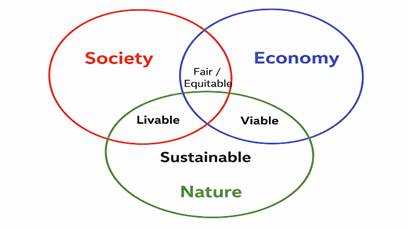
The following figure illustrates this connection clearly.
Figure 2: The interconnection of the three dimensions of sustainability
Source:Al-Ayib Abdul Rahman, the previous reference, p. 34.
The definitions of sustainable development vary significantly based on the perspective from which it is examined:
4. Case Study of Amazon
Amazon is considered one of the largest and most influential global companies in the fields of e-commerce, technology, and digital services. The company was founded in 1994 by Jeff Bezos in Seattle, United States, where it initially started as an online bookstore before gradually transforming into a global, multi-business corporation offering a wide range of products and digital and technological services (Stone, 2013).
Amazon’s success has been closely linked to the ambitious strategic vision of its founder, Jeff Bezos, who aimed to transform the company into “The Everything Store,” an online platform capable of meeting the diverse needs of consumers worldwide. The company adopted a business model based on continuous innovation, gradual expansion, and long-term investment, enabling it to achieve rapid growth and become one of the world’s largest companies in terms of market value and revenue (Lashinsky, 2012).
One of the key factors contributing to Amazon’s success is its flexible and dynamic organizational structure, which has enabled it to adapt quickly to the rapid changes in the business environment and global markets. The company has built an organizational culture based on innovation, fast decision-making, teamwork, and continuous improvement of operations and services (Dumaine, 2020).
In addition, heavy investment in technology is one of the core pillars of Amazon’s success. From its early stages, management recognized that digital technology would be the main driver of future growth. Therefore, Amazon invested heavily in developing its digital platforms, information systems, artificial intelligence, and big data analytics to enhance operational efficiency and improve customer experience (Brynjolfsson & McAfee, 2017).
Inventory management is one of the most strategic components of Amazon’s business model. The company relies on advanced systems and technologies aimed at improving supply chain efficiency, accelerating delivery processes, and achieving high levels of customer satisfaction. These intelligent systems have made Amazon one of the most advanced companies in global e-commerce and logistics (Christopher, 2022).
Amazon faces major challenges in managing millions of products and daily orders across a global network of hundreds of warehouses and distribution centers. Therefore, the company relies on artificial intelligence, predictive analytics, intelligent robotics, and warehouse management systems to ensure smooth and efficient inventory flow while reducing operational costs (Ivanov & Dolgui, 2021).
Inventory management is particularly critical for Amazon due to continuously changing customer behavior and rising expectations regarding delivery speed and service quality. Modern consumers expect extremely fast delivery times, which pushes Amazon to develop intelligent systems capable of accurate and real-time demand forecasting and inventory management.
Recent studies indicate that delivery delays or stockouts lead to lower customer satisfaction and a shift toward competitors, negatively affecting product rankings and sales on the platform (Kotler & Keller, 2022). Conversely, maintaining excessively high inventory levels results in capital being tied up and increased storage costs, especially given the reliance on large-scale fulfillment centers and fast shipping services.
Therefore, Amazon relies on integrated Inventory Management Systems (IMS), which are digital tools and technologies used to track product movement, quantities, and locations within the supply chain, with the aim of:
- Improving operational efficiency,
- Reducing costs,
- Accelerating delivery processes,
- Enhancing inventory accuracy,
- Ensuring product availability at the right time.
4.1 Fulfillment by Amazon (FBA)
Fulfillment by Amazon (FBA) is one of the most important logistics systems used by Amazon for inventory management. This service allows sellers to store their products in Amazon warehouses, while Amazon handles the entire logistics process on their behalf.
These operations include:
- Receiving products from suppliers or sellers,
- Storing products in warehouses,
- Picking and packing orders,
- Shipping products to customers,
- Managing returns,
- Providing customer service.
The FBA system has significantly improved inventory management efficiency and reduced operational burdens on sellers. It has also enabled Amazon to offer fast delivery services such as Amazon Prime, which is one of the company’s key competitive advantages (Stone, 2013).
FBA also relies on intelligent algorithms to analyze demand and strategically allocate inventory across its global warehouse network, reducing delivery times and transportation costs.
Amazon relies on advanced Warehouse Management Systems (WMS), which are digital systems used to organize and track daily operations within warehouses and distribution centers.
This system plays a central role in:
- Determining product storage locations,
- Monitoring goods movement,
- Managing picking and packing processes,
- Coordinating shipping and distribution,
- Real-time inventory tracking.
Amazon uses intelligent systems based on real-time data and advanced analytics to optimize storage space utilization and reduce operational errors.
The WMS also helps improve order processing speed, especially given the massive scale of daily global operations managed by the company (Christopher, 2022).
Intelligent robots are among the most important technologies used by Amazon in inventory and warehouse management. The company has heavily invested in automation since acquiring Kiva Robotics in 2012, which later became known as Amazon Robotics.
These robots are used for:
- Moving shelves and goods,
- Sorting products,
- Speeding up order picking processes,
- Reducing manual employee movement,
- Improving storage efficiency.
These robots operate in integration with artificial intelligence and computer vision systems, being automatically guided within warehouses using intelligent algorithms that determine the shortest and most efficient routes (Dumaine, 2020).
Automation systems have contributed to:
- Reducing order fulfillment time,
- Increasing productivity,
- Lowering operational costs,
- Minimizing human errors,
- Improving warehouse safety.
These systems have also enabled Amazon to handle massive order volumes during peak seasons such as Black Friday and Cyber Monday.
Based on Amazon’s financial statements and operational data for 2017, the main indicators were as follows:
| Item | value |
| Cost of Goods Sold (COGS) | 241.54 billion USD |
| Average Inventory Value | 20.40 billion USD |
| Inventory Holding Costs | 4.08 billion USD |
| Value of Damaged and Lost Inventory | 0.204 billion USD |
| Rate of Use of Intelligent Systems | 55% |
The inventory turnover ratio is considered one of the most important indicators used to measure the efficiency of inventory management, as it shows the number of times an organization sells and replenishes its inventory during a fiscal year.
It is calculated by dividing the cost of goods sold by the average inventory value, and it equals 11.84 times.
Result Analysis
This result indicates that Amazon sold and replenished its inventory approximately 12 times during 2017, reflecting a relatively good level of operational efficiency and inventory movement speed. A higher turnover ratio also indicates the company’s strong ability to convert inventory into sales effectively and reduce the amount of idle or obsolete stock in warehouses.
However, this level of performance was still moderately dependent on intelligent systems, as the rate of AI-based system usage in inventory management was only about 55%.
The average inventory holding period represents the number of days that inventory remains in warehouses before being sold or dispatched.
It is calculated by dividing 365 by the inventory turnover ratio. Accordingly, the average inventory holding period for Amazon in 2017 was 30.82 days.
This value indicates that products remained in Amazon’s warehouses for approximately 31 days before being sold or shipped to customers. This indicator reflects the efficiency of inventory management and the speed of product flow within the supply chain.
It also demonstrates Amazon’s ability to maintain a relatively balanced level between product availability and reduced storage time. However, this performance still had room for improvement through the expansion of artificial intelligence and predictive analytics technologies.
This indicator measures the percentage of annual costs associated with holding inventory relative to the average inventory value.
It is calculated as the ratio of annual inventory holding costs to the average inventory value, and it amounted to 20%.
This percentage reflects a moderate to relatively high financial burden borne by Amazon due to storage, insurance, handling, maintenance, and spoilage costs. It also indicates that there are opportunities to improve inventory management efficiency and reduce operational costs through the use of intelligent systems and automation technologies.
This indicator measures the percentage of damaged or lost products relative to the total inventory value. The damaged and lost inventory ratio in 2017 was 1%.
This percentage indicates a relatively acceptable level of efficiency in inventory management, especially considering the large scale of Amazon’s logistics operations. However, the presence of inventory losses reflects ongoing issues related to damage during storage or transportation, as well as operational errors.
The rate of intelligent systems usage in inventory management during 2017 was:55%
This percentage reflects that Amazon was in a transitional phase toward full digital transformation, where the company had begun expanding the use of artificial intelligence, robotics, and intelligent analytics. However, reliance on traditional systems was still significant at that time.
Based on Amazon’s financial and operational data for 2023, the indicators were as follows:
| Item | Value |
| Cost of Goods Sold (COGS) | 482.31 billion USD |
| Average Inventory Value | 36.85 billion USD |
| Inventory Holding Costs | 6.633 billion USD |
| Value of Damaged and Lost Inventory | 0.331 billion USD |
| Rate of Use of Intelligent Systems | 93% |
Applying the previous formula:
The inventory turnover ratio for 2023 equals:13.09 times
This result indicates a clear improvement in inventory management efficiency compared to 2017, as Amazon became capable of selling and replenishing its inventory at a faster rate. It reflects the effectiveness of artificial intelligence and predictive analytics in improving logistics planning and demand forecasting.
Conclusion
In light of rapid digital transformations and continuous advancements in artificial intelligence technologies, inventory management has become a critical field experiencing fundamental changes in management approaches and decision-making within modern organizations. This study demonstrates that artificial intelligence is an effective strategic tool for improving inventory management efficiency through predictive analytics, machine learning, intelligent robotics, and modern automation systems.
The case study of Amazon shows that the expansion of AI usage has significantly improved inventory performance indicators, leading to higher inventory turnover, reduced holding periods, lower inventory costs, reduced damaged and lost goods, and improved responsiveness to demand alongside enhanced logistics efficiency.
Moreover, Amazon’s reliance on intelligent systems and automation has enabled it to achieve high levels of operational efficiency and flexibility in supply chain management, strengthening its competitive advantage and enabling fast and efficient global customer service delivery.
The findings confirm that artificial intelligence is no longer merely a supportive technological tool, but a core element in achieving operational excellence and sustainability within organizations, especially in modern business environments characterized by large data volumes, operational complexity, and rapidly changing demand patterns.
Study Findings
The study reached the following key findings:
- Artificial intelligence significantly improves inventory management in modern organizations.
- The use of intelligent systems at Amazon improved inventory turnover and reduced storage duration.
- AI technologies helped reduce inventory-related operational costs.
- Intelligent tracking systems and robotics reduced damaged and lost inventory.
- Inventory management efficiency at Amazon heavily depends on predictive analytics and demand forecasting algorithms.
- The integration of AI with warehouse management systems improved order processing speed and customer satisfaction.
- Artificial intelligence plays an important role in enhancing supply chain sustainability and reducing waste.
Study Recommendations
In light of these findings, the following recommendations can be made:
- Increase investment in artificial intelligence technologies to improve inventory and supply chain management.
- Develop digital infrastructure and adopt intelligent systems in logistics operations.
- Expand the use of predictive analytics and machine learning to improve demand forecasting accuracy.
- Train human resources in the use of modern technologies and intelligent systems.
- Encourage organizations to adopt smart warehouses and robotics to enhance operational efficiency.
- Strengthen integration between inventory management systems, big data, and IoT technologies.
- Ensure high data quality as a critical factor for the effectiveness of AI systems.
Bibliographie
- Chopra, S., & Meindl, P. (2023). Supply chain management: Strategy, planning, and operation (8th ed.). Pearson.
- Christopher, M. (2022). Logistics and supply chain management (6th ed.). Pearson.
- Heizer, J., Render, B., & Munson, C. (2020). Operations management: Sustainability and supply chain management (13th ed.). Pearson.
- Ivanov, D., & Dolgui, A. (2021). A digital supply chain twin for managing the disruption risks and resilience in the era of Industry 4.0. Production Planning & Control, 32(9), 775–788.
- Queiroz, M. M., Ivanov, D., Dolgui, A., & Wamba, S. F. (2022). Impacts of epidemic outbreaks on supply chains: Mapping a research agenda amid the COVID-19 pandemic. Annals of Operations Research, 319(1), 115–141.
- Slack, N., Brandon-Jones, A., & Burgess, N. (2022). Operations management (10th ed.). Pearson.
- Bag, S., Gupta, S., Kumar, A., & Sivarajah, U. (2021). Role of technological dimensions of green supply chain management practices on firm performance. Journal of Enterprise Information Management, 34(1), 1–27.
- Choi, T. M., Wallace, S. W., & Wang, Y. (2018). Big data analytics in operations management. Production and Operations Management, 27(10), 1868–1883.
- Christopher, M. (2022). Logistics and supply chain management (6th ed.). Pearson.
- Ivanov, D., & Dolgui, A. (2021). A digital supply chain twin for managing disruption risks and resilience in the era of Industry 4.0. Production Planning & Control, 32(9), 775–788.
- Queiroz, M. M., Ivanov, D., Dolgui, A., & Wamba, S. F. (2022). Impacts of epidemic outbreaks on supply chains: Mapping a research agenda amid the COVID-19 pandemic. Annals of Operations Research, 319(1), 115–141.
- Wamba, S. F., Gunasekaran, A., Akter, S., et al. (2020). Big data analytics and firm performance: Effects of dynamic capabilities. Journal of Business Research, 70, 3
- Brynjolfsson, E., & McAfee, A. (2017). Machine, platform, crowd: Harnessing our digital future. W. W. Norton & Company.
- Christopher, M. (2022). Logistics and supply chain management (6th ed.). Pearson.
- Dumaine, B. (2020). Bezonomics: How Amazon is changing our lives and what the world’s best companies are learning from it. Scribner.
- Iansiti, M., & Lakhani, K. R. (2020). Competing in the age of AI: Strategy and leadership when algorithms and networks run the world. Harvard Business Review Press.
- Kotler, P., & Keller, K. L. (2022). Marketing management (16th ed.). Pearson.
- Lashinsky, A. (2012). Inside Apple: How America’s most admired—and secretive—company really works. Business Plus.
- Al-Sharif Habila. (2007). Genetic Structuralism in Literary Criticism: A Lucien Goldmann Perspective. 140-158.
- Robert Humphrey. (2000). Stream of Consciousness in the Arabic Novel. Cairo.
- Abdullah Rakibi. (1985). Memories of the Algerian Revolution 1954-1958. Reghaia: National Book Foundation.
- Lucien Goldmann, Jacques Dubois, Yon Pascaoui, Jean Dauphineau, Jacques Linhart, and R. Handels. (1986). Genetic Structuralism and Literary Criticism.
- Muhammad Al-Dahi. (2007). Ambiguous Truth: A Reading in Forms of Writing about the Self. Casablanca: Al-Madaris Publishing and Distribution Company.
- Muhammad Al-Qadi, Muhammad Al-Khabu, Ahmad Al-Samawi, Muhammad Najib Al-Amawi, Ali Ubaid, Nour Al-Din Batkhoud, … Muhammad Ait Mihoub. (n.d.). Dictionary of Narratology. Beirut: Dar Al-Farabi. Hisham Bakri. (2021). Structural-Genetic Theory: Principles and Foundations. Journal of Thought Results, 160-176.